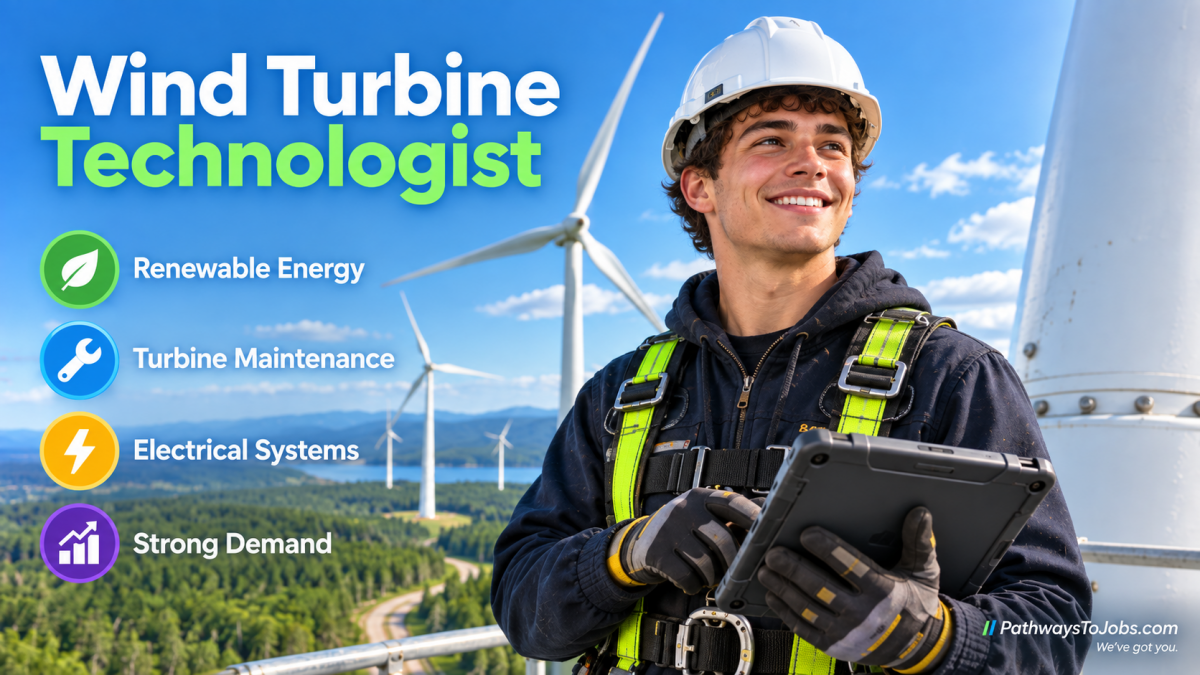
Wind Turbine Technician
Wind Turbine Technician
Career Overview
Wind Turbine Technicians install, inspect, maintain and repair wind turbines used to generate electricity. They work with mechanical, electrical and computer-controlled systems to keep turbines operating safely and efficiently.
Education
Most Wind Turbine Technicians complete a college certificate or diploma in wind turbine technology, renewable energy, electrical technology or mechanical technology. Training usually includes electrical and mechanical systems, hydraulics, turbine maintenance, troubleshooting, and safety procedures. Technicians may also complete working-at-heights, first aid and rescue training, along with additional employer or manufacturer-specific training.
Work Environment
Wind Turbine Technicians work mainly at wind farms, both onshore and offshore. The job includes working outdoors, climbing tall turbine towers, working in confined spaces and travelling to different sites. Technicians use safety equipment and may work in changing weather conditions.
Future Outlook
The future outlook for Wind Turbine Technicians is strong as wind energy continues to expand. Growing renewable-energy projects will create demand for technicians who can install, maintain and repair wind turbines.
Recommended High School Courses
- Computer Science
- Physics
- Computer-aided Design Competency
- Mathematics
- Electricity
- Manufacturing Technology
- Active Learning - Understanding the implications of new information for both current and future problem-solving and decision-making.
- Communicatiion - Sharing ideas clearly and understanding what others need from an AI system.
- Mechanical - Knowledge of machines and tools, including their designs, uses, repair, and maintenance.
- Problem Solving - Using logical and creative thinking to find solutions to challenges.
- Teamwork - Working cooperatively with others toward a shared goal, contributing individual strengths while supporting colleagues to achieve collective success.
- Technology Design - Generating or adapting equipment and technology to serve user needs.
- Trouble Shooting - Finding and fixing problems when an AI tool, prompt, or process doesn't work as expected.
- Computer Systems - Understanding how computer hardware, software, and networks work together to run AI tools.
- Computers and Electronics - Knowledge of circuit boards, processors, chips, electronic equipment, and computer hardware and software, including applications and programming.
- Engineering and Technology - Knowledge of the practical application of engineering science and technology. This includes applying principles, techniques, procedures, and equipment to the design and production of various goods and services.
- Physics - Knowledge and prediction of physical principles, laws, their interrelationships, and applications to understanding fluid, material, and atmospheric dynamics, and mechanical, electrical, atomic and sub- atomic structures and processes.
- Active Listening - Giving full attention to what other people are saying, taking time to understand the points being made, asking questions as appropriate, and not interrupting at inappropriate times.See more occupations related to this skill.
- Complex Problem Solving - Identifying complex problems and reviewing related information to develop and evaluate options and implement solutions.See more occupations related to this skill.
- Critical Thinking - Using logic and reasoning to identify the strengths and weaknesses of alternative solutions, conclusions or approaches to problems.
- Identify Risk - Spot potential threats, vulnerabilities, or negative consequences in AI systems, processes, or decisions before they cause harm.
- Mathematical Reasoning - The ability to choose the right mathematical methods or formulas to solve a problem.
- Solve Problems - Use logical and creative thinking to find effective solutions to challenges.
- Evaluate projects to determine compliance with technical specifications.
- Inspect wind turbines and equipment
- Perform routine maintenance
- Diagnose mechanical and electrical problems
- Repair or replace turbine components
- Test electrical systems and controls
- Monitor turbine performance
- Climb towers to service equipment
- Read technical diagrams and manuals
- Use diagnostic tools and computerized systems
- Record maintenance and repair work
- Follow safety procedures
- Inspect blades, gearboxes, generators, and braking systems
- Troubleshoot faults and system alarms
- Work with maintenance and engineering teams
Schools